
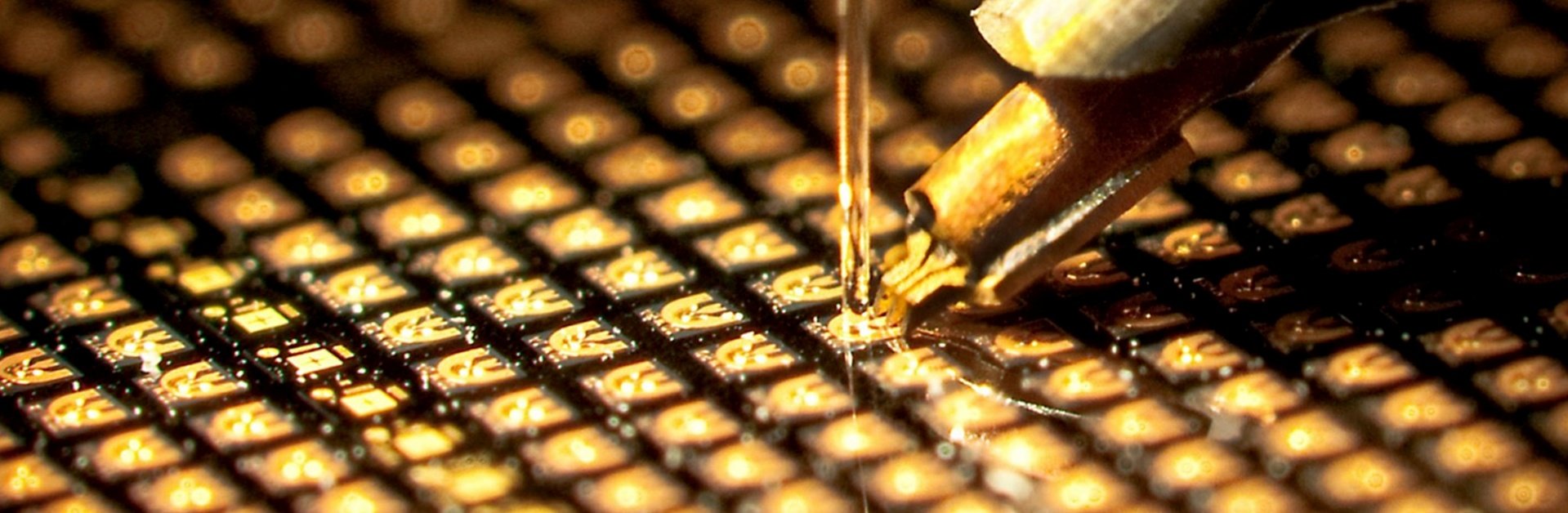
Advancing 3D Sensing VCSEL Technology in 2024
As a dedicated VCSEL manufacturer, we see 3D sensing moving from a “nice-to-have” feature to a core technology in consumer, automotive, medical and industrial systems. At Ace Photonics, our 3D sensing VCSEL solutions are designed to deliver stable power, precise wavelength control and high efficiency for next-generation depth sensing.
What Is a 3D Sensing VCSEL?
A VCSEL, or Vertical-Cavity Surface-Emitting Laser, is a semiconductor laser that emits light vertically from the surface of the chip instead of from its edge. This surface-emitting structure supports full wafer-level testing, excellent wavelength stability and scalable arrays—all critical benefits for 3D sensing applications where reliability and uniformity matter.
In 3D sensing, VCSELs typically emit near-infrared light. The emitted light is projected into the scene, reflected by objects and captured by an image sensor. By analyzing the time it takes the light to return (Time-of-Flight, or ToF) or the pattern distortion (structured-light methods), the system reconstructs a dense 3D map of the environment.
Why VCSELs Are Ideal for 3D Sensing
From a manufacturer’s standpoint, 3D sensing VCSELs combine optical performance with production scalability:
High measurement accuracy – Narrow spectral width and controllable beam divergence support fine depth resolution and clean 3D point clouds.
High electrical-to-optical efficiency – Modern VCSEL designs can exceed 45% wall-plug efficiency at room temperature, reducing system power budgets in battery-driven devices.
Compact, flexible form factors – Wafer-surface emission enables dense addressable arrays and compact packages, simplifying integration into thin smartphones, wearables and miniaturized modules.
Robust temperature behavior – Stable output across a wide operating range is essential for outdoor LiDAR, in-cabin monitoring and harsh industrial environments.

Where 3D Sensing VCSELs Are Used Today
Consumer Electronics and Smart Devices
In smartphones and tablets, 3D sensing VCSELs power facial recognition, secure payment authentication, gesture control and room-scale AR experiences. Our single-mode VCSEL dies, covering roughly the 750–900 nm band, are designed to provide stable output and polarization for compact depth cameras integrated behind display glass or protective windows.
Automotive and Mobility
In vehicles, 3D sensing VCSELs enable driver monitoring, in-cabin occupancy tracking and short-range LiDAR for ADAS. Low divergence beams and micro-optics arrays allow precise illumination zones, supporting accurate obstacle detection while meeting strict eye-safety requirements.
Healthcare and Medical Instrumentation
Medical imaging systems use VCSEL-based 3D sensing for patient positioning, surface mapping, and as excitation sources in optical measurement systems. The inherent wavelength stability and high modulation speed of VCSELs are especially beneficial for sensors that track subtle changes over time.
Industrial Automation and Robotics
In factories and logistics centers, 3D sensing VCSELs feed robots, AGVs and quality-inspection stations with accurate spatial data. Wafer-level testability and scalable arrays help OEMs roll out depth sensors across entire product families while maintaining tight performance tolerances.
Recent Technical Advances in 3D Sensing VCSELs
Higher Precision and Stability
New epitaxial structures and cavity designs improve linewidth control and reduce noise, supporting finer depth steps and more consistent performance across large VCSEL arrays. At Ace Photonics, we focus on vertical resonant cavity structures, current confinement and thermal management to maintain stable emission under dynamic operating conditions.
Better Energy Efficiency
For 3D sensing, every milliwatt matters. Efficiency improvements at the chip level translate directly into longer battery life and smaller thermal budgets. Our devices are engineered for low threshold current and high slope efficiency, helping customers keep overall module power down while still achieving strong IR illumination.
Miniaturization and Integration
Demand for smaller modules is pushing continuous miniaturization:
Chip-level micro-optics arrays enable diffuser-less illuminators, reducing package size while shaping the beam for either flood or structured-light projection.
Integrated temperature control – We integrate VCSEL chips with temperature sensors and TEC options to maintain wavelength and output stability in compact modules.
Cost-Effective Manufacturing
Because VCSELs emit from the wafer surface, they can be fully tested before dicing, which reduces downstream scrap and supports high-volume production. Wafer-level processes and scalable die designs help us lower cost per channel while maintaining the reliability required in automotive and medical markets.
3D Sensing VCSEL Trends to Watch in 2024
Tighter Coupling with AI and Edge Processing
3D sensing VCSEL hardware increasingly works hand in hand with AI accelerators on the edge. High-quality depth maps from VCSEL-based ToF sensors feed neural networks for tasks like scene segmentation, driver attention tracking and gesture recognition. This places more emphasis on consistent illumination and low-noise point clouds.
Smarter, Multi-Functional Sensor Modules
System makers are moving toward modules that combine 3D sensing VCSELs, RGB cameras and environmental sensors in a single unit. From a manufacturer’s perspective, this trend favors compact, thermally optimized VCSEL packages with robust polarization and wavelength control to avoid cross-talk between subsystems.
Expanded Wavelength Options and Quantum-Adjacent Use
While 3D sensing commonly uses near-infrared bands, some applications benefit from wavelengths optimized for specific materials or quantum media. Ace Photonics offers VCSELs around 760–895 nm that can support both classical 3D sensing and advanced sensing such as chip-scale magnetometers or quantum-enhanced instruments, allowing OEMs to explore hybrid use cases.
How 3D Sensing VCSELs Are Transforming Industries
AR/VR and Spatial Computing
For AR headsets and VR devices, 3D sensing VCSELs provide room-scale tracking and hand-tracking with low latency. Compact arrays and high modulation speeds help the system maintain an accurate understanding of the user’s environment, reducing motion sickness and improving immersion.
Safer Automotive Systems
As vehicles evolve toward higher autonomy, 3D sensing VCSELs support in-cabin monitoring, near-field LiDAR and parking assistance. Their symmetric, low-divergence beams and fast rise/fall times enable precise, rapidly updating distance measurements—critical for collision avoidance and adaptive cruise systems. ACE PHOTONICS
More Capable Medical and Laboratory Devices
In healthcare and life-science instruments, the combination of wavelength stability, non-magnetic packaging (where required) and fine power control helps engineers build sensitive diagnostic tools. When paired with advanced sensors and algorithms, VCSEL-based illumination supports earlier detection and more consistent measurements, especially in optical and quantum-inspired systems.
Smarter Factories and Logistics
Factories rely on reliable depth sensing for bin picking, pallet detection and inline inspection. VCSEL arrays with wafer-level testability and flexible packaging give OEMs the confidence to install 3D sensing across multiple production lines, from robotic arms to conveyor systems.
Ace Photonics: A Partner for 3D Sensing VCSEL Solutions
From VCSEL Die to Complete Modules
Ace Photonics offers a full portfolio of VCSEL components:
VCSEL dies with vertical resonant cavities, current confinement and array-ready layouts.
VCSEL packages and modules, including TO46, SMD and non-magnetic options, designed for integration into 3D sensing cameras, LiDAR engines and optical instruments.
Gain chips and OEM packages for customers who need tailored performance in their own external-cavity or system architectures.
Customized Designs for 3D Sensing
Every 3D sensing application has its own constraints: field of view, eye-safety class, working distance and mechanical envelope. Leveraging our experience in GaAs-based VCSEL development, advanced processing (ICP etching, wet oxidation, BCB processes) and aerospace-grade payloads, we customize epitaxial structures, device geometries and packaging to meet specific system-level requirements.
Tackling Key 3D Sensing VCSEL Challenges
Optical Performance and Beam Quality
3D sensing systems are sensitive to beam shape and uniformity. We focus on:
Low divergence beams with symmetric profiles
Linear polarization options for structured light and flood illumination
Tight wavelength tolerance over temperature (typically within a few nanometers) to improve SNR at the receiver.
Reliability in Harsh Environments
Our VCSELs are designed for high reliability and can operate at elevated ambient temperatures, making them suitable for demanding automotive and industrial environments where thermal management is challenging. Wafer-level testing and rigorous screening routines help ensure long-term stability.
Seamless System Integration
We work closely with customers’ optical, mechanical and electronics teams to ensure that VCSEL dies, packages and modules integrate smoothly into their 3D sensing architectures. Flexible packaging options and clear electro-optical models reduce time-to-market for new depth-sensing products.
Looking Ahead: The Future of 3D Sensing VCSELs
Going into 2024 and beyond, we expect 3D sensing VCSEL technology to become even more tightly integrated into everyday products—phones, cars, medical instruments and factory equipment. Continued improvements in efficiency, miniaturization, wavelength control and packaging will allow depth sensing to spread into new form factors and new markets.
At Ace Photonics, our goal is to provide OEMs and system integrators with reliable, customizable 3D sensing VCSEL building blocks—from bare die to fully integrated modules—so they can design the next generation of intelligent, spatially aware devices.