
Purpose-Built for Quantum technology
We develop precision VCSEL solutions for atomic clocks, quantum technology,
and advanced photonic systems for research, industrial, and emerging quantum applications.
Suppressing Laser Noise in SERF Magnetometers: Polarization Stability of 795 nm VCSELs
Spin-exchange relaxation-free (SERF) magnetometers operate in a demanding corner of quantum sensing. Reaching sensitivities below 1 fT/√Hz requires managing ambient magnetic gradients, thermal fluctuations, electronic drift, and optical noise. In high-density alkali vapor cells, light-atom interactions dictate the sensitivity threshold. Frequency stabilization and intensity leveling are well-established engineering targets, but polarization stability in vertical-cavity surface-emitting lasers (VCSELs) frequently limits overall performance.
When circularly polarized light drives optical pumping at the rubidium D1 line (795 nm), minor variations in laser polarization purity convert directly into spurious magnetic signals. Suppressing this noise demands an understanding of microcavity laser physics, polarization-locking techniques, and non-magnetic device packaging.
The SERF Detection Principle and Noise Sources
SERF magnetometers eliminate atomic spin relaxation caused by spin-exchange collisions by running alkali metal vapor at elevated temperatures (typically 150°C to 200°C) inside a near-zero magnetic field ( B < 1nT ). Under these conditions, the spin-exchange collision rate significantly exceeds the Larmor precession frequency, preventing collision-induced decoherence.
Signal Transduction and Noise Breakdown
While spin-projection and photon shot noise define theoretical performance boundaries, laser technical noise usually dominates low-frequency bands (< 100 Hz), precisely where biomagnetic signals reside.
The Rubidium D1 Line and Optical Pumping Dynamics
Mechanisms of Polarization Jitter in 795 nm VCSELs
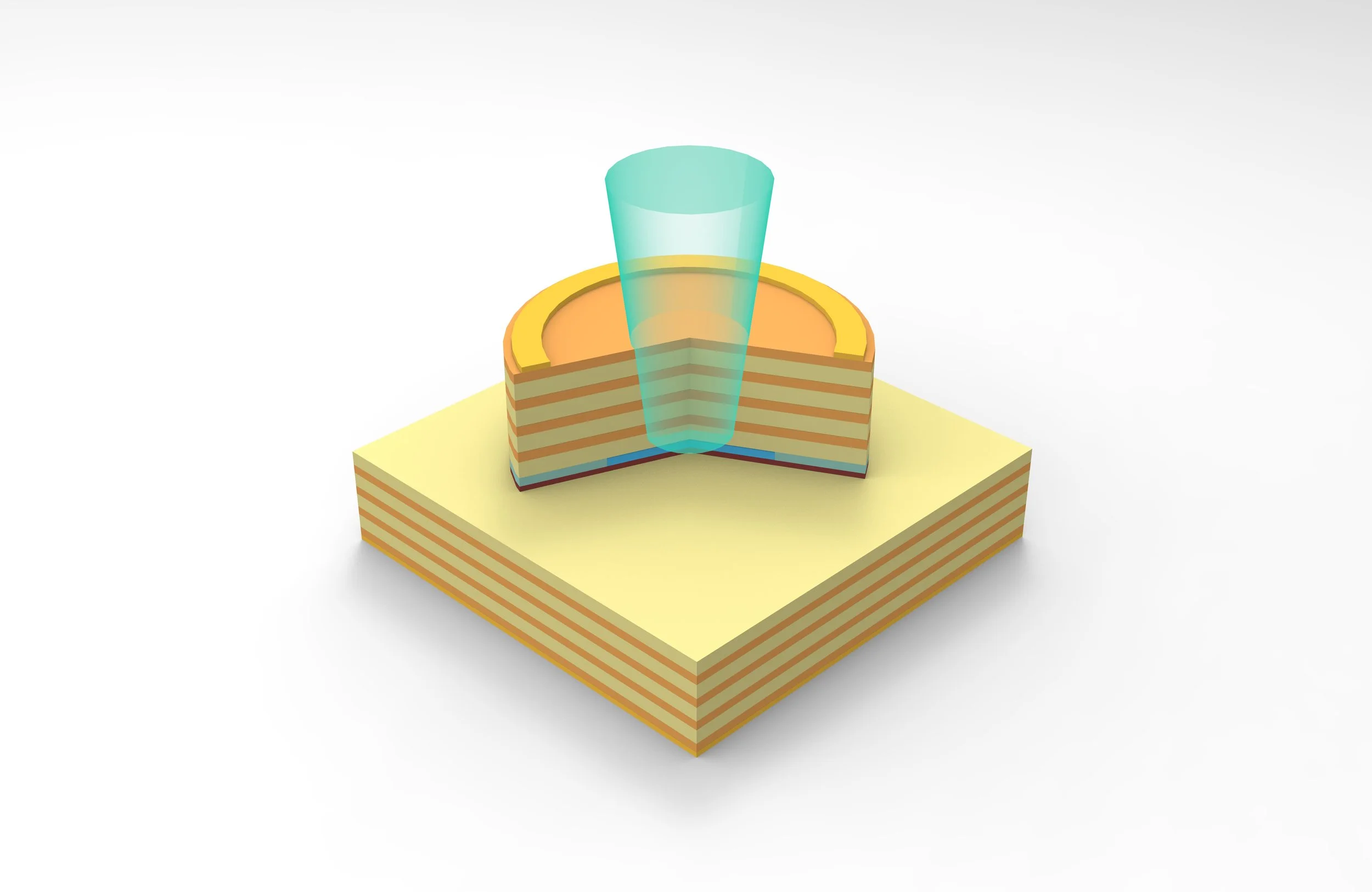
VCSELs are widely chosen for miniaturized atomic sensors due to milliwatt-level power efficiency, single-longitudinal-mode emission, circular beam output, and compatibility with wafer-scale fabrication. However, their structural symmetry introduces unique polarization vulnerabilities.
Birefringence: Residual material strain, photoelastic effects, and electro-optic contributions split these modes by several gigahertz.
Thermal Gradients & Current Flips: As injection current or ambient temperature changes, relative modal gains shift. Without stabilizing structures, the laser undergoes polarization switching or exhibits polarization partition noise, where energy fluctuates randomly between the two states.
Structural Comparison of Stabilized Emitters
High Orthogonal Polarization Suppression Ratios (OPSR) prevent mode hopping across wide temperature and current tuning ranges. This preserves optical alignment with quarter-wave plates, eliminating amplitude noise converted from polarization variations.
Packaging Considerations: The Non-Magnetic Imperative
Sensor performance depends heavily on the materials housing the laser. Operating a SERF magnetometer requires maintaining residual magnetic fields below 1 nT, with field gradients below 10 pT/cm across the vapor cell.
Standard optoelectronic packaging utilizes ferromagnetic components:
Kovar Caps & Leads: Iron-nickel-cobalt alloys chosen for thermal expansion matching to glass seals.
Nickel Underplates: Standard electroplated diffusion barriers beneath gold wire-bonding pads.
Ferromagnetic materials positioned within several centimeters of the cell distort the zero-field environment. Remanent magnetization creates persistent offsets, while thermal fluctuations introduce continuous magnetic field drift.
Non-Magnetic Packaging Solutions
At Ace Photonics Co., Ltd., we address this constraint by manufacturing dedicated non-magnetic packaging solutions for our 795nm and 895nm 1mW VCSEL platforms. Designed specifically for quantum sensing and atomic clocks, these configurations eliminate ferromagnetic elements:
Metallurgical Isolation: Titanium headers, copper-tungsten heat sinks, and phosphor-bronze leads replace Kovar and nickel.
Pure Solder Alloys: Gold-tin (AuSn) eutectic solder replaces standard nickel-bearing alloys for die attach and submount assembly.
Custom Enclosures: Housing dimensions, pin assignments, and optical window materials (sapphire, BK7, or tailored anti-reflective coatings) can be configured to support either zero-field quantum sensing or shielded magnetic setups.
Removing local ferromagnetic materials stabilizes the zero-field operating point, ensuring the sensor operates within its optimal sensitivity window.
Application in Wearable Magnetoencephalography (MEG)
Magnetoencephalography records the millisecond-scale magnetic fields generated by neuronal currents within the human brain. Traditional MEG relies on Superconducting Quantum Interference Device (SQUID) arrays, which require liquid helium cooling and rigid, stationary dewars.
Using a compact 795 nm VCSEL for rubidium optical pumping within an integrated Optically Pumped Magnetometer (OPM) makes wearable MEG caps viable. Sensor heads operate reliably close to the scalp only when the laser maintains stable optical power and polarization without local magnetic contamination.
Technical Summary
Achieving sub-femtotesla sensitivity in SERF magnetometers requires managing technical laser noise alongside quantum spin dynamics. Polarization jitter in 795 nm VCSEL sources acts as a hidden noise source, converting microcavity birefringence shifts directly into baseline drift and apparent magnetic fluctuations.
Using polarization-locked VCSEL architectures—complemented by non-magnetic assembly methods—suppresses optical conversion noise, stabilizing the pump beam for high-density atomic systems.
Frequently Asked Questions
1. Why is the D1 line preferred over the D2 line for SERF optical pumping?
2. How narrow must the spectral linewidth of a 795 nm VCSEL be for SERF applications?
SERF vapor cells contain high pressures of buffer gas (often 1 to 3 atmospheres of helium or nitrogen), broadening the atomic absorption spectrum to between 10 GHz and 30 GHz. A single-mode VCSEL with a standard linewidth of 50 MHz to 100 MHz operates well within this broadened absorption envelope, delivering high optical pumping efficiency without requiring the sub-megahertz linewidths needed for unbroadened beam spectroscopy.
3. Can external polarizers correct for VCSEL polarization drift?
External high-extinction linear polarizers and quarter-wave plates can enforce clean circular polarization, but they do not eliminate the underlying instability. If the laser's native polarization switches or wanders, passing it through a fixed linear polarizer translates the angular shift into amplitude noise (intensity jitter). This variation in pump intensity alters the atomic pumping rate, introducing secondary baseline drift. Polarization stability must originate within the laser cavity itself.
4. What defines a package as "non-magnetic" for quantum magnetometry?
A non-magnetic package must exhibit low residual remanence and low magnetic susceptibility across its operational temperature profile. Traditional packaging metals like Kovar, nickel, and specific stainless-steel grades must be replaced with non-ferrous alternatives such as phosphor bronze, titanium, oxygen-free high-conductivity (OFHC) copper, or copper-tungsten. Finished assemblies are typically screened via fluxgate or SQUID test stations to verify that residual signatures stay below picotesla thresholds at short working distances.
5. Why are VCSELs selected over DFB or ECDL lasers for multi-channel arrays?
External Cavity Diode Lasers (ECDLs) and Distributed Feedback (DFB) lasers offer exceptional spectral purity, but they consume watts of power, require complex drivers, and demand extensive fiber-optic routing to support multi-channel arrays. VCSELs draw only tens of milliamperes, emit directly from the wafer surface, and can be integrated directly inside compact sensor heads. This makes them the primary laser architecture for lightweight, multi-channel MEG systems where heat, weight, and footprint must be minimized.