
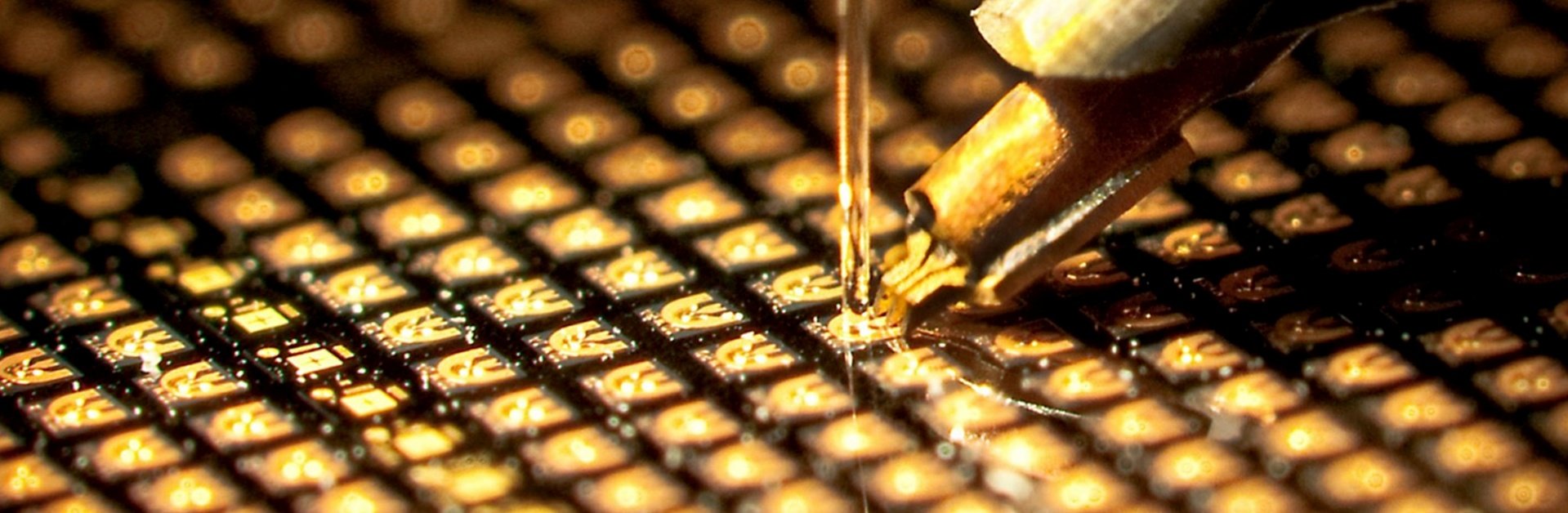
VCSEL Chips (Die) for Datacom and Sensing Application
In modern networks and intelligent devices, the same component now powers both ultra-fast data links and precise sensing systems: VCSEL chips (die) for datacom and sensing application. As a VCSEL manufacturer, Ace Photonics designs these die-level lasers to balance speed, efficiency and reliability so that data centers, 3D sensors and quantum instruments can all rely on a common, scalable light source.
What Makes VCSEL Chips Different?
VCSEL stands for Vertical-Cavity Surface-Emitting Laser. Unlike edge-emitting lasers, which radiate from the cleaved chip edge, VCSELs emit light vertically from the surface of the wafer. This geometry:
Enables wafer-level testing before dicing and packaging
Makes it easy to build dense 1D and 2D arrays
Supports compact, cost-effective optical engines for both datacom and sensing
Each VCSEL chip contains a vertical resonant cavity and carefully engineered mirrors and quantum wells. When current flows through the active region, the device generates coherent light with tightly controlled wavelength and output power—exactly what high-speed links and precision sensors need.
Why Speed Matters in Datacom
Cloud workloads, AI inference and streaming traffic are all pushing short-reach optical links to higher data rates. Inside data centers, servers and switches depend on optical transceivers based on VCSEL die to move huge volumes of data across just a few meters of fiber.
By integrating VCSEL chips (die) for datacom into optical modules and active optical cables, system designers can:
Achieve multi-gigabit per second data rates over multimode fiber
Reduce power per transmitted bit compared with many legacy solutions
Maintain signal integrity thanks to clean eye diagrams and stable modulation
For operators, that translates into higher rack density, more throughput per watt and simpler thermal design.

Extending VCSEL Performance into Sensing
The same strengths that make VCSELs attractive for datacom—efficiency, compact size and wavelength control—are equally valuable in sensing. Ace Photonics VCSEL die are configured for a wide range of sensing applications, including:
3D time-of-flight and structured-light cameras in consumer and industrial systems
Gas and environmental sensors that rely on narrowband IR light
Medical and physiological monitoring, such as SpO₂ and tissue oxygen sensing
Quantum and atomic sensors that need VCSELs tuned to specific absorption lines
This convergence means one technology platform can support both high-speed optical links and high-precision measurements, simplifying the component strategy across product lines.
How VCSEL Chips (Die) Operate
At device level, a VCSEL chip combines several key structures:
Distributed Bragg Reflectors (DBRs) above and below the active region to form a short vertical cavity
Quantum wells engineered for the target wavelength band
Current-confinement structures (such as oxide apertures) that funnel carriers into the lasing region
Metallization and pads tailored for wire-bonding or flip-chip assembly into packages and modules
This architecture lets engineers precisely control threshold current, beam profile and modulation behavior. In data links, that supports clean, high-speed modulation. In sensing, it ensures stable wavelength and output power across temperature.
Advantages Over Traditional Edge-Emitting Lasers
Compared with many edge-emitting laser diodes, VCSEL chips offer several practical benefits:
Lower power consumption
Efficient cavity design and low threshold currents help reduce power draw at the link or sensor level, which is critical in dense racks and battery-powered devices.Simplified packaging and arrays
Surface emission allows the creation of 1D and 2D arrays without complex alignment, ideal for 3D sensing and multi-channel links.Wafer-level test and better scalability
Devices can be fully characterized at wafer level, improving yield and lowering cost per channel in volume production.Compact, application-specific footprints
From die-level integration into custom modules to standardized packages, VCSELs fit easily into tight mechanical envelopes.
Datacom Use Cases: From Racks to Boards
High-Speed Optical Interconnects
VCSEL chips (die) sit at the core of many short-reach optical communication links, including:
Optical transceivers between servers and top-of-rack switches
Active optical cables for high-performance computing
Board-to-board or rack-to-rack links where copper reaches its limits
Here, VCSEL die are paired with dedicated laser drivers that provide stable bias and modulation current over wide temperature ranges, while protecting the laser from transients and over-current.
Fiber Connectivity
In multimode fiber systems, VCSELs couple efficiently into standard fibers, enabling cost-effective, high-bandwidth links over the distances typical of data halls and enterprise networks.
Sensing Applications: Beyond Communication
3D Sensing and LiDAR
Dense VCSEL arrays illuminate scenes for depth cameras and time-of-flight sensors. When combined with microlens arrays and compact optics, VCSEL die provide uniform, controllable illumination for:
Face and gesture recognition in consumer devices
Industrial machine vision and robotics
Short-range LiDAR and safety sensing
Medical and Environmental Monitoring
Narrow-linewidth VCSELs in the near-infrared are used to probe tissue or gas absorption lines. Stable output power and wavelength translate directly into more reliable measurements in:
SpO₂ and respiration monitoring
Optical gas detection and air-quality sensing
Quantum and Precision Sensing
For atomic magnetometers, clocks and related quantum sensors, VCSELs are tuned to specific atomic transitions and often integrated in non-magnetic packages. Maintaining spectral purity and polarization stability is key, and Ace Photonics designs die and packages specifically for these conditions.
Benefits of Using VCSEL Chips (Die)
High Bandwidth and Data Integrity
When combined with the right driver electronics, VCSEL die support multi-gigabit data rates with low jitter and fast rise/fall times. This ensures clean eye diagrams and robust data integrity in optical links.
Energy Efficiency at Scale
Low threshold currents and efficient operation reduce energy per bit in datacom and extend battery life in portable sensing devices. At data-center scale, even small improvements in efficiency translate into meaningful power and cooling savings.
Reliability and Cost-Effectiveness
Wafer-level test, mature GaAs processing and robust packaging deliver long device lifetimes and predictable performance. For large deployments, this reliability reduces maintenance costs and downtime.
Design and Integration Considerations
Thermal Management
Although VCSELs are efficient, thermal design still matters—especially in high-density arrays and hot environments. Careful attention to heat-spreading, PCB design and package choice helps maintain wavelength stability and lifetime. Ace Photonics offers high-temperature VCSEL solutions and recommends pairing them with appropriate thermal management strategies.
Packaging and Form Factor
From bare die for direct integration, to TO-can, ceramic and custom non-magnetic packages, the choice of package affects:
Thermal performance
Optical alignment and coupling
Mechanical robustness and integration effort
For sensing systems, window materials and AR coatings are also important, especially when targeting specific wavelengths or operating in harsh environments.
Driver Electronics
A well-chosen VCSEL laser driver is essential. It must deliver:
Precise bias and modulation currents
Protection against surges and ESD
Monitoring hooks for photocurrent, temperature or fault conditions
Application-tuned drivers allow the same VCSEL die platform to serve both high-speed datacom and low-noise sensing roles.
Looking Ahead: Future Directions for VCSEL Chips
Research and product development around VCSEL chips (die) for datacom and sensing application continue to accelerate. Key trends include:
Higher speed and modulation formats for next-generation data centers
Larger and more efficient arrays for high-resolution 3D sensing
More compact, integrated modules combining VCSELs, drivers and optics
Specialized wavelengths and packages for emerging quantum and biomedical use cases
Why Work with Ace Photonics
Ace Photonics focuses on GaAs-based VCSEL technology across 750–1550 nm, supplying VCSEL die, packages, modules and gain chips for demanding datacom and sensing applications. With deep process expertise and a strong background in quantum and high-temperature systems, the company supports customers from early prototyping through high-volume production.
Whether you are upgrading short-reach optical links, building a new 3D sensing platform or developing next-generation quantum instruments, VCSEL chips (die) for datacom and sensing application from Ace Photonics provide a scalable, energy-efficient light source that can be tuned to your exact requirements.