
How to Read a VCSEL Datasheet: A Manufacturer’s Guide
As a dedicated VCSEL manufacturer, we spend a lot of time designing, measuring and documenting our devices before any part ever reaches your lab bench. A VCSEL datasheet is the distilled result of that work: it tells you what the laser can do, where it performs best, and where the limits are.
On the Ace Photonics site, for example, each VCSEL die or package in the 760–900 nm range (such as 790/795 nm and 890/895 nm single-mode devices) is accompanied by a downloadable datasheet that summarizes its key performance parameters and package options, including non-magnetic variants for quantum applications.
This guide walks you through those datasheets from a manufacturer’s point of view, so you know exactly what to look for when evaluating VCSELs for 3D sensing, quantum sensing, oxygen monitoring, optical communication and other precision uses.
1. What Is a VCSEL?
A Vertical-Cavity Surface-Emitting Laser (VCSEL) is a semiconductor laser where the beam exits perpendicular to the chip surface instead of from the edge. This surface-emission geometry allows:
Wafer-level testing of every die
Efficient array layouts
Symmetric, low-divergence beams
High efficiency with low power consumption
Because of these advantages, VCSELs are widely used in:
3D facial recognition and depth cameras
LiDAR and time-of-flight systems
Quantum and atomic sensing
Oxygen and gas sensors
Optical communication links
When you read a VCSEL datasheet, you’re essentially reading a compact story about how that particular device behaves in these environments.
2. Why the VCSEL Datasheet Matters
From our side as a manufacturer, we use the datasheet to:
Communicate safe operating limits
Show typical and guaranteed performance
Explain package, pinout and mounting details
Document reliability and environmental robustness
From your side as a designer, the VCSEL datasheet lets you:
Confirm that wavelength and output power match your optical design
Check efficiency and threshold current for power budgeting
Verify that the package and pinout fit your board or module
Ensure the device can survive your temperature and vibration conditions
Compare several VCSEL options side by side before committing to a design
If you treat the datasheet as part of the design process (not just as a formality at the end), you’ll avoid most integration problems.
3. General Information in a VCSEL Datasheet
3.1 Manufacturer and Part Number
Near the top of the datasheet you’ll find:
Manufacturer name – for example, Ace Photonics
Part / model number – often encoding wavelength, output power and package
This is the anchor for your internal documentation and purchasing system. When you contact us for support or customization, this part number is what we use to pull up the exact epitaxial structure, test data and available options.
3.2 Product Description and Applications
The description usually summarizes:
Central wavelength band (e.g., 760–763 nm, 790/795 nm, 890/895 nm)
Output power class (e.g., 0.1 mW, 1 mW, 1.8 mW)
Package options (bare die, TO-can, SMD, non-magnetic package, modules)
It also highlights typical application fields, such as quantum magnetometers, medical instrumentation, 3D sensing modules or optical networks.
Use this section as a quick filter: if the intended use isn’t mentioned at all (for example, you need non-magnetic packaging inside a shielded quantum sensor), that’s a signal to check carefully or request a customized version.
4. Absolute Maximum Ratings
The absolute maximum ratings table defines the “do not cross” boundaries. As a manufacturer, we test and rate devices so that operation beyond these points risks permanent damage.
Typical entries include:
Maximum forward current (If,max) – the largest continuous current allowed
Peak pulse current (if specified) – higher, but only for brief pulses at low duty cycle
Maximum reverse voltage – above this, junction breakdown can occur
Maximum optical output power – often implied by the current and thermal design
Operating temperature range – e.g., from sub-zero to high ambient temperatures
Storage temperature range
Some of our VCSEL technologies are rated for ambient operation up to around 150 °C; even then, staying comfortably within the specified limits improves lifetime.
How to use this section:
Design your driver so that the worst-case current (including tolerances and transients) remains below the maximum.
Keep both junction and ambient temperature inside the listed range, especially in sealed optics or high-power arrays.
Treat peak ratings strictly as short-term limits, never as continuous drive conditions.
5. Electrical Characteristics
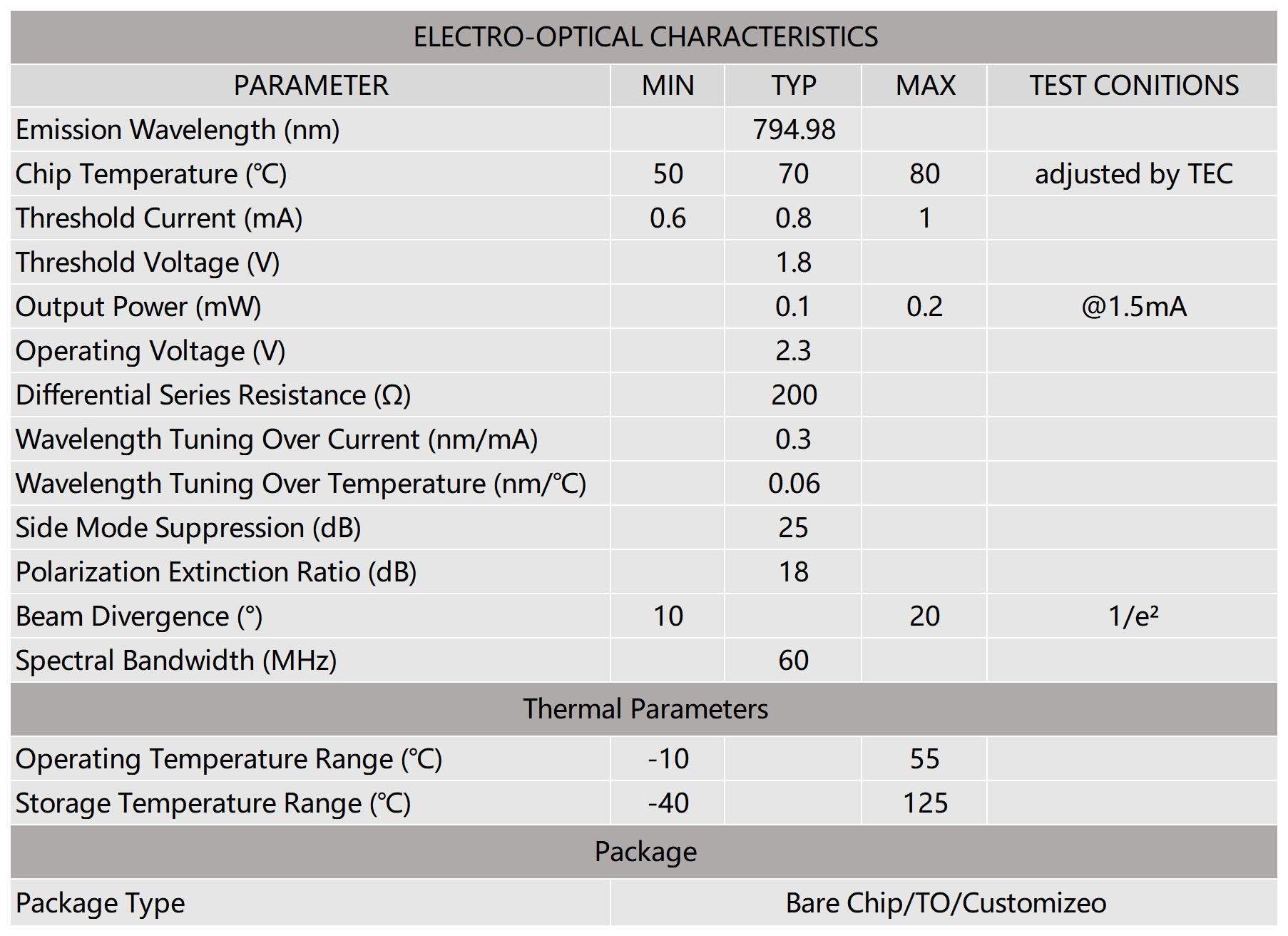
Under “Electrical Characteristics” (sometimes “DC Characteristics”), the VCSEL datasheet presents how the laser behaves electrically near its recommended operating point.
Typical parameters include:
5.1 Threshold Current (Ith)
The minimum current at which stimulated emission starts and the device becomes a laser.
Below Ith, output behaves like an LED; above Ith, power rises more sharply.
A lower threshold current generally means lower power consumption and less self-heating, which is particularly important in compact quantum or 3D sensing modules.
5.2 Forward Voltage (Vf)
The voltage across the VCSEL at a given forward current.
Used to size your supply rails and estimate electrical power (P ≈ Vf × If).
Look for Vf values at the actual currents you plan to use (e.g., 1–5 mA for low-power single-mode devices, higher for arrays). This helps you check whether your driver has enough headroom.
5.3 Slope Efficiency and Differential Efficiency
Slope efficiency (often in mW/mA) expresses how much optical power increases per milliamp of extra current above threshold.
It is closely linked to wall-plug efficiency and thermal load.
Higher slope efficiency means less electrical power is wasted as heat for a given optical output — crucial for dense arrays and thermally restricted environments.
5.4 Other Electrical Entries You May See
Depending on the specific device, the datasheet may also include:
Series / differential resistance
Modulation bandwidth
Rise and fall times
These are especially important for high-speed communication and fast time-of-flight ranging.
6. Optical Characteristics
For most users, the optical characteristics table is the heart of the VCSEL datasheet.
6.1 Wavelength and Spectral Behavior
Key wavelength-related entries usually include:
Center wavelength (λc) – e.g., 795 nm or 895 nm for atomic sensing and quantum magnetometers, or other bands within 750–900 nm.
Tolerance (e.g., ±1–2 nm)
Temperature coefficient of wavelength (nm/°C), reflecting the device’s temperature stability.
VCSELs are known for excellent wavelength stability over temperature, which is one reason they are preferred in precision sensing and spectroscopy.
6.2 Output Power
You’ll typically see:
Optical output power at a specified drive current
Sometimes a range (minimum/typical/maximum)
Ace Photonics devices, for example, include several output power classes (0.1 mW, 1 mW, 1.8 mW) to match work from ultra-low power sensing up to higher-power illumination and pumping.
Always confirm that:
The listed power meets your detector’s dynamic range
Beam safety and eye-safety requirements are satisfied
Your optics (filters, lenses) can handle the maximum specified power
6.3 Beam Divergence and Mode Profile
Look for:
Beam divergence (typically given as full-width at half-maximum in degrees)
Beam shape (often close to circular and symmetric for VCSELs)
Mode behavior (single-mode or multi-mode, polarization information)
VCSELs usually provide symmetric, low-divergence beams, which simplifies coupling into free-space optics or fibers and is a strong advantage over many edge-emitting diodes.
Some datasheets, especially for quantum and sensing products, also mention:
Polarization control (e.g., linear polarization)
Linewidth (MHz range for narrow-line devices)
These properties are particularly important in quantum sensing and atomic spectroscopy.
7. Mechanical Dimensions and Pin Configuration
7.1 Package Type
The mechanical dimensions section tells you how the device fits into your hardware:
Bare die – for direct integration on custom sub-mounts or modules
TO-can packages – convenient for lab setups and many OEM modules
SMD packages – for high-volume board-level integration
Non-magnetic packages – designed to avoid ferromagnetic materials in sensitive quantum sensors
Drawings typically show:
Package outline (diameters, heights)
Pad or lead dimensions
Reference planes for alignment
Match these to your 3D model or PCB layout before committing to production.
7.2 Pin Configuration
The pin configuration diagram and table define:
Anode and cathode pins / pads
Optional thermistor, TEC or monitor diode pins
Ground and case connections where applicable
Always verify orientation and numbering against the drawing; many integration errors come from mirrored footprints or swapped pins.
8. Reliability, Lifetime and Environmental Tolerances
8.1 Reliability Metrics
Manufacturers often summarize reliability with:
MTBF (Mean Time Between Failures) or FIT rates
Stress test conditions (e.g., high-temperature operating life, accelerated aging)
Ultra-stable VCSELs for quantum sensing and aerospace environments undergo more stringent testing and screening. Ace Photonics leverages experience from aerospace payload development to support such demanding cases.
8.2 Environmental Robustness
The environmental section typically covers resistance to:
Temperature cycling
High humidity and condensation
Mechanical shock and vibration
If your device is destined for field instruments, automotive platforms or airborne payloads, pay special attention to these lines and compare them with your qualification plan.
9. Practical Tips for Using a VCSEL Datasheet
9.1 Start from Your Application Requirements
Before diving into numbers, clarify:
Required wavelength band and tolerance
Target output power and safety class
Beam shape and divergence constraints
Operating temperature range and environment
Package and integration constraints (non-magnetic, SMD, TO, module)
Then scan the VCSEL datasheet for exactly those parameters first. Treat everything else as supporting detail.
9.2 Compare Devices Parameter by Parameter
When evaluating different VCSELs:
Put their key specs in a small table: wavelength, power, Ith, efficiency, package, operating temperature, and MTBF.
Eliminate parts that fail any hard requirement (e.g., wrong wavelength or insufficient temperature range).
Among the remaining candidates, look for the best combination of efficiency, reliability and ease of integration.
On the Ace Photonics product pages, multiple wavelength/power options are listed side by side, each linked to its own datasheet, which makes such comparisons straightforward.
9.3 Read the Footnotes and Graphs
Footnotes and graphs often explain:
Test conditions (temperature, duty cycle, drive waveform)
Whether values are typical or guaranteed
Any caveats on measurement methods
Current–power curves, Vf–If curves or wavelength-versus-temperature plots are especially useful for verifying your driver design and thermal model.
9.4 Ask the Manufacturer for Clarification
If anything is unclear — a parameter you don’t see, an unusual test condition, or a requirement for custom packaging — contact the manufacturer with the part number and your application description.
Suppliers like Ace Photonics routinely customize chip design, epitaxy and packaging (including non-magnetic headers and integrated temperature control) for specific customer requirements.
10. Common Mistakes to Avoid
Ignoring temperature limits
Designing as if the VCSEL were at room temperature while it actually runs hot in a sealed module can drastically shorten lifetime. Always consider self-heating and ambient temperature together.Confusing continuous and peak ratings
Peak pulse current is not a continuous operating point. Use continuous ratings for CW or high duty-cycle operation.Overlooking package and pin details
A perfect optical/electrical fit is useless if the package doesn’t match your PCB footprint or your system requires a non-magnetic header that isn’t supported by the chosen part.Assuming wavelength is “close enough”
In quantum, spectroscopy and certain sensing setups, a small wavelength mismatch can dramatically reduce signal quality. Confirm the specified wavelength and its stability with respect to temperature.
11. Conclusion: Using VCSEL Datasheets to Build Better Systems
A VCSEL datasheet is more than a list of numbers — it is your roadmap to safe operation, high performance and long-term reliability. By focusing on:
Absolute maximum and recommended operating conditions
Electrical parameters such as threshold current and forward voltage
Optical properties like wavelength stability, output power and beam divergence
Mechanical, pin, reliability and environmental specifications
you can select VCSELs that truly fit your sensing, communication or quantum application.
As a VCSEL manufacturer, Ace Photonics offers a portfolio of single-mode devices and customized packages, along with detailed datasheets and engineering support, to help you move from specification to working system with confidence.
Use the datasheet as a design tool, not an afterthought, and your VCSEL-based products will be easier to integrate, more robust in the field, and ready for the next generation of quantum and 3D sensing applications.