
VCSEL Design: Practical Considerations from a Manufacturer’s View
As a dedicated VCSEL manufacturer, Ace Photonics treats VCSEL design as the core lever for performance, reliability and cost. A well-engineered VCSEL structure determines how far your LiDAR sees, how stable your quantum sensor is, and how small your module can be.
Below we share how we approach VCSEL design for sensing and communication applications, drawing on our experience with single-mode VCSELs, VCSEL arrays, and non-magnetic packages.
Understanding VCSEL Technology
What Is a VCSEL?
A VCSEL (vertical-cavity surface-emitting laser) is a semiconductor laser that emits light perpendicular to the chip surface instead of from a cleaved edge. This vertical emission:
Enables wafer-level testing before dicing and packaging
Supports compact, scalable arrays
Offers high efficiency and low power consumption compared with many edge-emitting lasers
Because VCSELs can be probed and characterized on the wafer, we can screen devices early, improve yield, and deliver more consistent performance in volume.
Where VCSEL Design Matters Most
A robust VCSEL design underpins a wide range of applications, including:
3D sensing and facial recognition
Automotive and industrial LiDAR
Short-reach optical communication and data center links
Quantum sensing and atomic magnetometers
Optical oxygen sensing and medical monitoring
Industrial and scientific instrumentation
ach use case drives different priorities in wavelength, modulation bandwidth, beam shape, packaging and reliability. Our job as a manufacturer is to translate those system-level requirements into the epitaxy, cavity, aperture, and package design of the VCSEL.
Key VCSEL Design Metrics
Core Performance Parameters
When we design a VCSEL for a customer, we typically consider at least the following metrics:
Output power and slope efficiency
Determines usable optical power at a given drive current
Drives system link budget or sensing range
Wavelength and linewidth
Center wavelength tolerance (e.g., around 760–900 nm)
Linewidth and stability over temperature and drive current
Beam quality and divergence
Symmetry of the far-field pattern
Divergence angle for coupling into optics, fibers or diffuser-less emitters
Modulation bandwidth
Small-signal and large-signal modulation response
Rise/fall times for pulsed LiDAR or high-speed datacom
Thermal resistance and junction temperature
How quickly heat is removed from the active region
Direct impact on lifetime and wavelength stability
Reliability indicators
Threshold current drift
Optical power degradation over accelerated stress
Mean time to failure (MTTF) targets for the end application
Balancing these metrics is the essence of VCSEL design: a device optimized only for peak power but not for thermal or wavelength stability usually fails in real systems.
Thermal Management by Design
Excessive junction temperature is one of the fastest ways to shorten VCSEL lifetime. We address thermal management at several levels:
Epitaxial and cavity design to minimize series resistance and heat generation
Aperture and contact geometry to spread current and avoid hot spots
Substrate thinning and metallization to provide efficient heat paths
Package choice (TO-can, SMD, modules, non-magnetic headers) with appropriate thermal conduction
Ace Photonics designs VCSELs to operate in demanding environments, with products qualified for high ambient temperatures and stringent stability requirements.
Wavelength Selection and Cavity Engineering
Application-Driven Wavelengths
The “right” wavelength is never arbitrary—it follows the physics of the application:
Quantum magnetometers and alkali-vapor cells often need emission near 795 nm and 895 nm for resonant pumping.
3D sensing and facial recognition typically use near-infrared bands that balance eye safety, detector sensitivity and ambient light rejection.
Optical oxygen sensors rely on specific absorption bands and compatible oxygen-sensitive dyes.
Optical communication prefers wavelengths where fiber or polymer-waveguide loss is low and components are mature.
Ace Photonics offers single-mode VCSELs spanning roughly the 750–900 nm range, including high-power 795/895 nm devices, to match these use cases.
Cavity and Linewidth Control
Cavity design determines:
Linewidth (critical for quantum and precision sensing)
Side-mode suppression
Polarization behavior
We tune layer thicknesses, mirror reflectivity and gain-cavity overlap to achieve narrow linewidths and stable polarization, particularly for atomic spectroscopy and high-precision instruments.
Materials and Manufacturing for VCSEL Design
GaAs-Based VCSEL Platforms
For the 750–900 nm band, GaAs-based VCSELs remain the workhorse technology. Ace Photonics has built deep expertise in GaAs VCSEL R&D and can customize epitaxial and device structures according to customer requirements.
The material system directly influences:
Emission wavelength
Efficiency and threshold current
Thermal conductivity and reliability
Integration with driver electronics and optics
Epitaxial Growth and Front-End Processing
We rely on advanced epitaxial growth methods (such as MBE or MOCVD) to build precise Bragg mirrors and active regions, then combine them with:
Inductively coupled plasma (ICP) etching
Wet oxidation
BCB and other passivation/planarization processes
These steps allow accurate aperture definition, current confinement and surface passivation—each of which strongly affects beam shape, efficiency, and lifetime.
Wafer-Level Testing and Quality Control
Because VCSELs emit from the wafer surface, we can:
Probe every die on the wafer
Map threshold current, output power and wavelength uniformity
Screen early for defects that would otherwise appear only after packaging
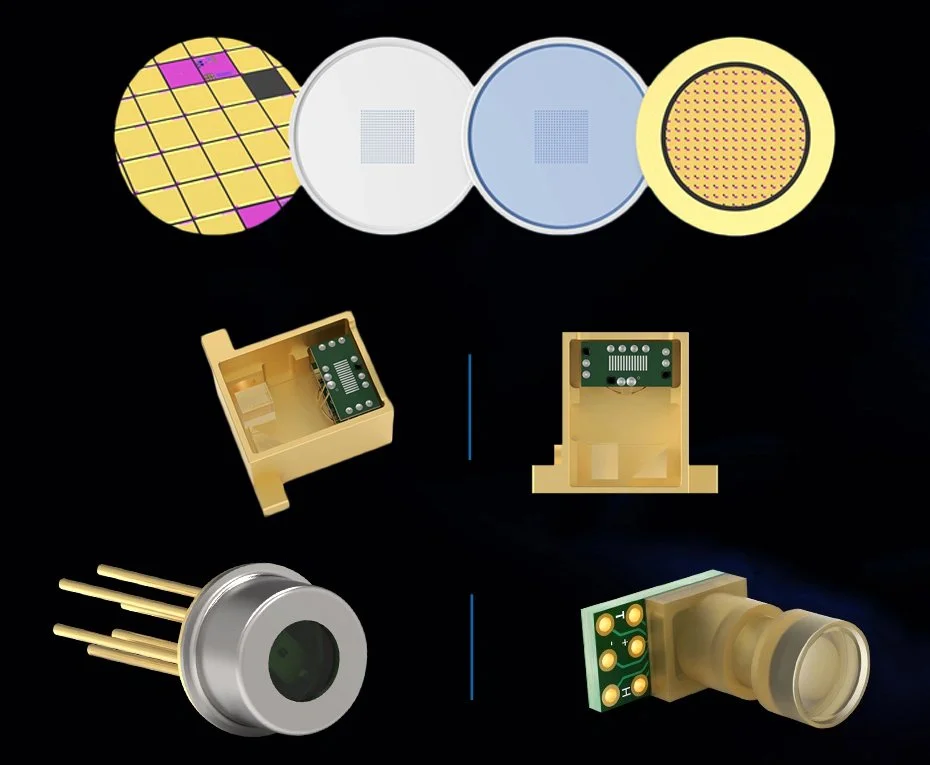
Ace Photonics combines wafer-level characterization with strict outgoing inspection of dies, SMDs, TO packages and custom modules to ensure consistent quality across batches.
Designing VCSELs for Specific Applications
Data and Optical Communications
For short-reach fiber or free-space links, VCSEL design focuses on:
High modulation bandwidth and low jitter
Tight wavelength control for multiplexing
Efficient coupling into fibers or integrated waveguides
Stable operation over data-center temperature ranges
By optimizing parasitic capacitance, contact layout and driver interface, we support high-rate signaling while keeping power consumption in check.
3D Sensing and Consumer Devices
In 3D sensing, the VCSEL must illuminate the scene with a well-controlled pattern:
Grid-type VCSEL arrays provide uniform structured light for depth mapping.
Beam shaping can often be done at chip level, reducing or eliminating external diffusers.
Stable wavelength and polarization improve signal-to-noise ratio in time-of-flight or structured-light systems.
Ace Photonics designs both single emitters and arrays for 3D sensing in mobile, consumer and industrial devices.
LiDAR and Industrial Ranging
LiDAR requires:
High peak optical power in short pulses
Fast rise/fall times
Tight control of eye-safety limits
Robust performance under automotive or outdoor conditions
We use tailored aperture sizes, optimized thermal paths and package designs to sustain high instantaneous power while preserving lifetime.
Quantum and Precision Sensing
Modern quantum sensors are extremely sensitive to noise and stray fields. Ace Photonics supports this segment with:
Single-mode VCSELs near 795 nm and 895 nm with narrow linewidths for pumping and probing quantum media.
Non-magnetic VCSEL packages that avoid ferromagnetic materials and minimize stray fields, boosting signal-to-noise in shielded enclosures.
Integrated thermistors and TECs for on-package temperature control at the °C level.
These features are particularly important for chip-scale atomic magnetometers and other quantum sensing platforms.
Oxygen Sensing and Medical Monitoring
For optical oxygen sensors, we design VCSELs that provide:
Wavelengths matched to oxygen-sensitive dyes
High modulation speed for rapid measurements
Stable output versus temperature for medical reliability
This combination improves sensitivity and accuracy in medical oxygen monitoring and industrial process control.
Optimization Strategies in VCSEL Design
Power Efficiency and Lifetime
To reduce power consumption and extend lifetime, we:
Optimize epitaxial gain and mirror design for high slope efficiency
Minimize series resistance in contacts and current paths
Match drive conditions to the VCSEL’s thermal characteristics
Efficient VCSELs reduce system-level heat load, simplify thermal design and allow more compact modules.
High-Speed Modulation
For datacom and fast LiDAR:
We minimize parasitic capacitance and inductance in both chip and package
Design pads and interconnects for clean RF behavior
Validate eye diagrams and jitter under realistic driver conditions
This ensures that the VCSEL can support the required bit rates or pulse shaping without distortion.
Beam Quality, Divergence and Polarization
Imaging and sensing systems are very sensitive to beam quality. We control:
Aperture size and shape to tune divergence and mode structure
Cavity anisotropy to stabilize polarization
Array layout to achieve the targeted illumination pattern
The result is a beam profile that is easier to model and integrate into optics.
VCSEL Arrays and Modules
As a VCSEL array manufacturer, Ace Photonics:
Optimizes array layout for power density, uniformity and thermal balance
Provides grid-type and application-specific array patterns for LiDAR and 3D sensing
Offers packaging options ranging from chip-on-board to custom modules for rugged environments
This lets customers choose between single emitters, arrays or fully integrated modules depending on integration level and time-to-market.
VCSEL Design Challenges and How We Address Them
Common Design Pitfalls
Some of the recurring issues we see in VCSEL projects are:
Insufficient thermal margin leading to wavelength drift and early degradation
Material or process defects that cause random failures
Wavelength choices that do not align with optics, sensors or regulations
Overly aggressive drive conditions without proper reliability testing
Practical Mitigations
To mitigate these risks, Ace Photonics:
Builds thermal simulations into the design process and validates with real measurements
Uses controlled fabrication processes with in-line monitoring and wafer mapping
Offers wavelength and package options tuned to specific applications (e.g., quantum, LiDAR, medical)
Runs accelerated lifetime testing and screens devices according to the target environment
This combination of design, process and testing helps ensure that the VCSEL design performs as expected in the field—not just in the lab.
Emerging Trends and Future Directions in VCSEL Design
VCSEL technology is moving quickly. Key trends include:
Higher-power VCSEL arrays for long-range LiDAR and high-bandwidth links
More flexible array layouts and beam-shaping techniques to support new sensing modalities
Improved energy efficiency and longer lifetimes through better epitaxy and processing
Closer integration of VCSELs with drivers, sensors and photonic integrated circuits
Ace Photonics’ roadmap focuses on new architectures, more efficient devices and packaging innovations to keep pace with these trends.
Ace Photonics: Your Partner for Custom VCSEL Design
At Ace Photonics, we combine GaAs-based VCSEL expertise, advanced processing (ICP etching, wet oxidation, BCB), and application-driven engineering to deliver tailored VCSEL designs—from single-mode lasers and non-magnetic devices to high-power arrays.
Whether you are developing:
A quantum sensor with strict linewidth and packaging constraints
A compact 3D sensing module for consumer devices
An automotive LiDAR system with demanding thermal and reliability targets
A medical or industrial sensor that depends on wavelength stability
…our team can work with you from concept and simulation through prototype and volume production.
If you are planning your next system around VCSEL design, we invite you to contact Ace Photonics to discuss wavelengths, packaging, arrays and reliability targets tailored to your application.