
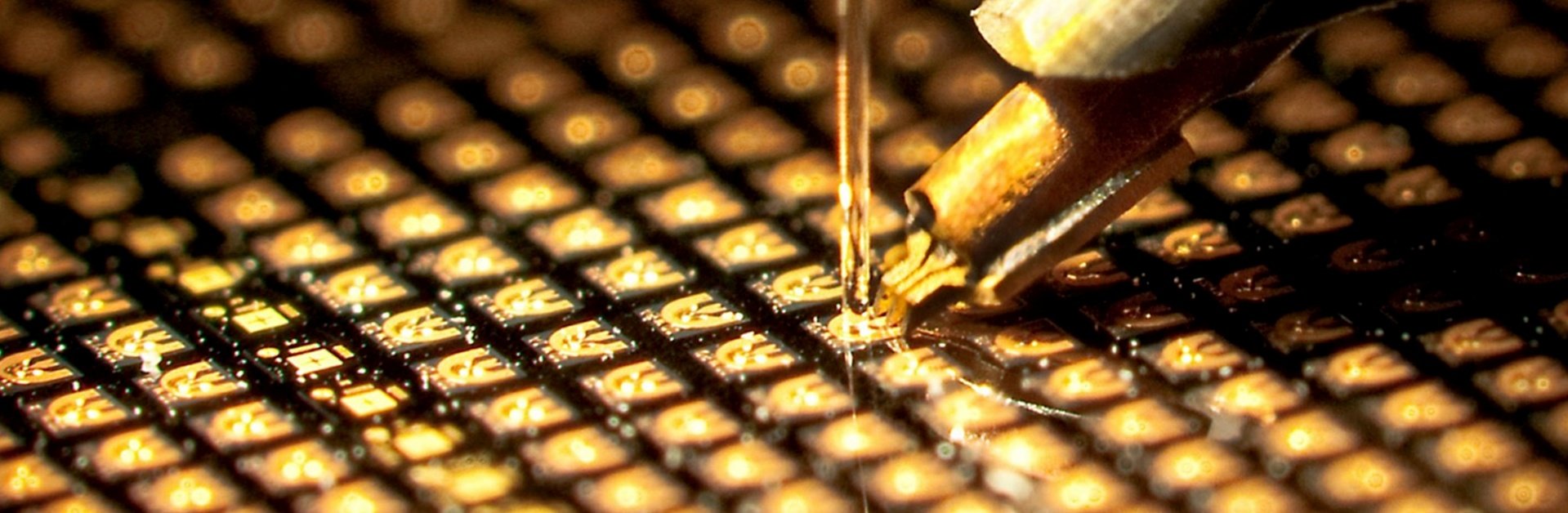
Ace Photonics VCSEL Fabrication for the Next Wave of Photonics
At Ace Photonics, VCSEL fabrication means owning the complete flow—from GaAs epitaxy and wafer processing to final module test. We combine GaAs-based epitaxial growth, fine-line lithography, controlled oxide or implant confinement, and strict reliability screens to build VCSELs that hold optical power, modulation speed, and wavelength stability over long field lifetimes.
Whether you need a single emitter for a quantum sensor or a high-density array for 3D sensing or datacom, we build to your electrical, optical, and packaging requirements and support you from early NPI through high-volume production.
Why Ace Photonics for VCSEL Fabrication
Process Depth Under One Roof
Our VCSEL manufacturing line keeps critical steps tightly linked in one process flow:
GaAs MOCVD/MBE epitaxy with engineered DBR mirror stacks
Precise mesa patterning and ion implantation
Selective oxidation to form stable oxide apertures
Front- and back-end metallization tailored to your package and assembly scheme
This integrated VCSEL fabrication approach shortens iteration cycles and reduces variability between lots.
Design-to-Fab Co-Engineering
We work as an extension of your design team. Together we tune:
Aperture size and cavity length to hit your threshold current, divergence, and linewidth targets
Mode control and current spreading to keep beam shape and polarization consistent over temperature
Thermal paths—from chip metallization to submount—to meet your R_th and lifetime requirements
Drive and system constraints, so the VCSEL matches your driver IC, optics, and mechanical stackup
Quality You Can Ship
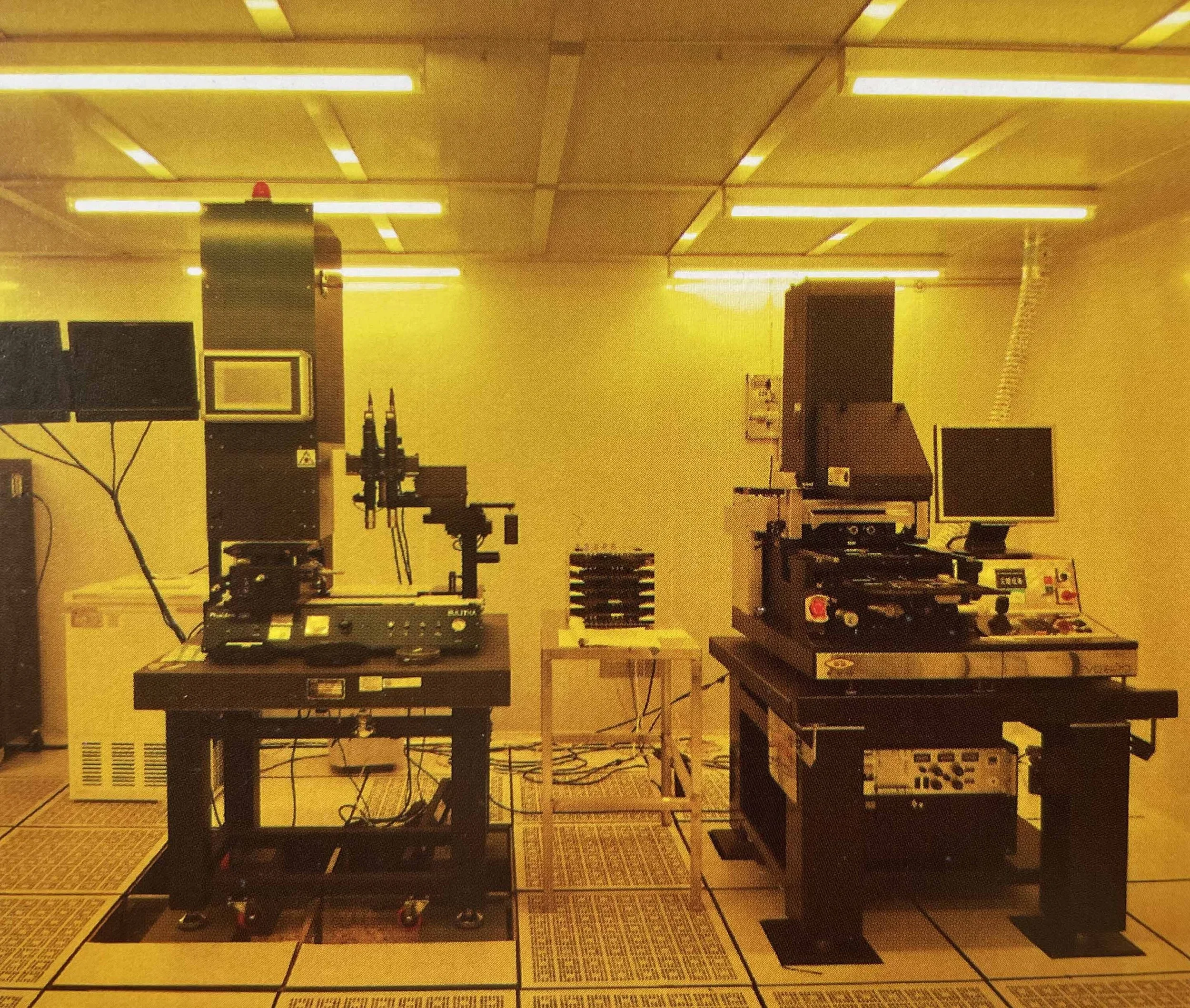
Our VCSEL fabrication flow is aligned with ISO 9001–style quality systems and statistical process control on critical steps such as epitaxy, oxidation, and lithography. Wafer-level LIV and spectral mapping allow early binning before singulation, so only devices that meet spec move into assembly and test.
Short Feedback Loops
For new designs, we support rapid mask spins and structured DOE lots. That lets you:
Lock in yield and uniformity early
Compare different oxide aperture sizes and cavity designs on the same wafer
De-risk performance before committing to volume tooling
Customized VCSEL Solutions
No two sensing stacks or optical links are exactly alike. Ace Photonics configures VCSEL fabrication around your application rather than forcing you into a fixed catalog.
Wavelengths for Sensing and Communications
Typical operating bands include the near-infrared regime used in:
Quantum and atomic sensing around rubidium and cesium transitions
3D sensing, facial recognition, and structured light
Short-reach datacom links and active optical cables
Within these windows we can fine-tune nominal wavelength and temperature behavior to match your filters and detectors.
Aperture and Cavity Engineering
We support a wide range of aperture diameters and cavity structures:
Oxide-confined apertures engineered for efficiency and mode control
Implant-confined structures where robustness and thermal headroom are paramount
Single-mode designs for narrow divergence and low noise
Multi-mode options for higher power and illumination applications
VCSEL Arrays
Ace Photonics manufactures both 1D and 2D VCSEL arrays, from a few emitters to large matrices with thousands of channels. We can provide:
Common-cathode or individually addressable layouts
Optimized pitch for diffractive or microlens optics
Consolidated pads and routing to simplify your PCB or flex design
Speed and Modulation
For datacom and short-reach fiber links, we target high-speed lanes with:
10 Gbps per lane as a baseline, with paths beyond 25 Gbps for advanced designs
Clean eye diagrams at operating temperature and bias
Fast rise/fall times for time-of-flight and pulsed systems
For sensing and ranging, we support pulsed operation, duty-cycled drive, and tailored modulation schemes that balance SNR, eye safety, and thermal load.
Packaging Options
Our VCSEL fabrication is paired with packaging routes such as:
TO-can and non-magnetic TO variants for quantum and precision sensing
SMD and chip-on-board assemblies for compact embedded designs
LGA/SMT substrates for high-density integration
Optics-integrated modules with microlenses or diffractive elements
Optional driver co-packaging for reduced parasitics and smaller footprints
VCSEL Fabrication Process at Ace Photonics
1. Epitaxy – Building the Optical Stack
We start with GaAs-based epitaxial growth of:
Lower and upper DBR mirrors
Quantum well active region
Confinement and current-spreading layers
Uniform epitaxy is central to threshold current, slope efficiency, and wavelength stability, so we control growth conditions and in-situ monitoring throughout the run.
2. Photolithography – Defining Features and Arrays
Sub-micron lithography defines mesas, apertures, and array pitch. Tight control of critical dimensions helps:
Maintain consistent resistance and capacitance
Keep optical modes stable across the wafer
Align array emitters to downstream optical structures
3. Etching – Sculpting the VCSEL Structure
We combine dry and wet etch steps to form mesas and expose the correct layers for oxidation and contacts. Etch profiles are tuned to:
Protect DBR mirror integrity
Enable repeatable oxide aperture placement
Control sidewall quality for long-term reliability
4. Current Confinement – Oxide Aperture or Implant
We use selective wet oxidation and/or ion implantation to define the current path and optical aperture. This step directly impacts:
Mode behavior and divergence
Differential resistance and thermal performance
Robustness under high-temperature and high-current operation
5. Metallization – Contacts and Redistribution
Low-resistance ohmic contacts and redistribution layers are designed for:
Uniform current injection across each aperture or array
Strong ESD performance
Compatibility with Au-free or low-gold stacks when required by your package or assembly process
6. Passivation and Wafer-Level Characterization
Dielectric passivation protects mirrors, sidewalls, and edges from contamination and moisture. Before dicing, we perform wafer-level tests such as:
LIV sweeps for threshold and efficiency
Spectral and wavelength uniformity mapping
Far-field beam profile checks
Thermal rollover tests
These wafer-level tests allow early binning and traceability, reducing cost and risk in later assembly stages.
7. Dicing, Assembly, and Final Test
After singulation, dies are:
Die-attached to the selected submount or header
Wire-bonded or flip-chipped, depending on the package design
Encapsulated, sealed, or integrated into modules with optics and thermal management
We finish with environmental and reliability screens tailored to your market—for example, HTOL, temperature cycling, humidity testing, and mechanical robustness checks.
Advanced VCSEL Fabrication Techniques at Ace Photonics
To push performance further, Ace Photonics uses advanced optimization techniques throughout the VCSEL fabrication flow:
DBR mirror engineering for target wavelength, linewidth, and temperature drift
Uniformity control via in-situ epi monitoring and post-epi mapping
Thermal path design from chip to system level to flatten R_th and extend lifetime at power
Array co-optimization, including crosstalk control, beam shaping, and microlens alignment strategies
These measures are especially important for demanding applications such as quantum sensors, high-precision instruments, and automotive LiDAR.
What You Gain with Ace Photonics VCSELs
High performance – Strong wall-plug efficiency, low threshold, and stable wavelength under load
Reliability and longevity – Designs and screening focused on HTOL, temperature cycling, humidity exposure, and ESD robustness
Cost efficiency – Wafer-level binning and high yield at common wavelengths reduce system-level costs and simplify your supply chain
Applications We Support
Ace Photonics VCSEL fabrication underpins a wide set of markets:
Telecom & Datacom – Short-reach links, active optical cables, co-packaged optics, and backplane relief
Data Centers – 850-nm class links with tight skew, fast turn-on, and narrow spectral width for high-density switches and servers
Consumer Electronics – 3D sensing, proximity and gesture recognition, and eye-safe depth mapping
Automotive – LiDAR and ToF illumination sources, as well as driver and occupant monitoring (DMS/OMS) with extended temperature range requirements
Industrial & Medical – Positioning, flow sensing, oxygen monitoring, quantum and atomic sensing, and other instruments that rely on stable beam profiles and wavelength control
Case Study Highlights
High-Speed Datacom Refresh
A networking customer needed higher line rates without excessive thermal penalties in the transceiver. Working jointly, we:
Tuned oxide aperture diameter and placement for better differential resistance
Optimized mirror stack design for the desired wavelength and slope efficiency
Qualified a package with improved thermal conductivity and reduced R_th
The result was a VCSEL that maintained eye-diagram quality at the new data rate while improving wafer-level yield and tightening wavelength distributions.
Precision Medical and Quantum Sensing
A medical/quantum sensing OEM required narrow divergence and tightly controlled pulse energy for consistent measurements. Ace Photonics:
Produced a custom array with tightly controlled aperture diameters and spacing
Implemented wafer-level binning on optical power and wavelength
Verified far-field distributions and pulse stability across temperature
The final module delivered repeatable illumination from unit to unit, reducing calibration time and improving system-level SNR.
The Road Ahead: Trends in VCSEL Fabrication
Looking forward, several trends are shaping VCSEL fabrication:
PIC integration and co-packaging – Closer integration with drivers and silicon photonics to reduce loss and footprint
More complex arrays – Higher emitter counts, addressable patterns, and advanced beam shaping for structured light and scanning
Sustainable manufacturing – Greater emphasis on water recycling, solvent recovery, and energy-efficient tools to reduce fab environmental impact
Ace Photonics continues to evolve its VCSEL fabrication platform around these directions, while keeping compatibility with existing system architectures.
Frequently Asked Questions
What makes VCSELs from Ace Photonics suitable for automotive use?
Rugged oxide apertures or implant structures, carefully engineered metallization, and market-specific qualification (HTOL, temperature cycling, humidity, vibration) help keep optical and electrical performance stable across the full automotive temperature and stress range.
How do you control wavelength drift in VCSEL fabrication?
We combine DBR mirror design, epitaxial uniformity, and thermal path engineering. Devices are characterized near their real operating temperature, and binning strategies help keep modules consistent in volume production.
Can you support custom VCSEL arrays?
Yes. We can configure pitch, emitter count, grouping, and pad layouts. For optical stacks, we also support alignment to microlenses or diffractive elements to achieve the beam shape and field of view your system needs.
Do you provide wafer-level data?
We can supply wafer-level LIV, spectral maps, far-field data, and other key parameters. This traceability supports smarter binning, system-level modeling, and long-term quality tracking.