

Purpose-Built for Quantum technology
We develop precision VCSEL solutions for atomic clocks, quantum technology,
and advanced photonic systems for research, industrial, and emerging quantum applications.
VCSEL Selection for Chip-Scale Atomic Magnetometers
The performance of a chip-scale atomic magnetometer depends heavily on its laser source. Wavelength drift, unstable polarization, optical noise, and magnetic contamination can all affect measurement accuracy. These issues become harder to manage as the distance between the laser and the atomic vapor cell decreases.
Vertical-cavity surface-emitting lasers (VCSELs) are widely used in miniature atomic sensors because of their compact dimensions, low operating current, and wavelength tunability. Selecting a suitable device requires careful consideration of optical performance, thermal stability, packaging materials, and system integration.
How a Chip-Scale Atomic Magnetometer Works
Atomic magnetometers detect magnetic fields by measuring changes in the spin behavior of alkali atoms, typically rubidium (Rb) or cesium (Cs). Laser light prepares the atoms in a polarized spin state through optical pumping. An external magnetic field alters their spin dynamics, producing changes in optical transmission or polarization that can be measured by a photodetector.
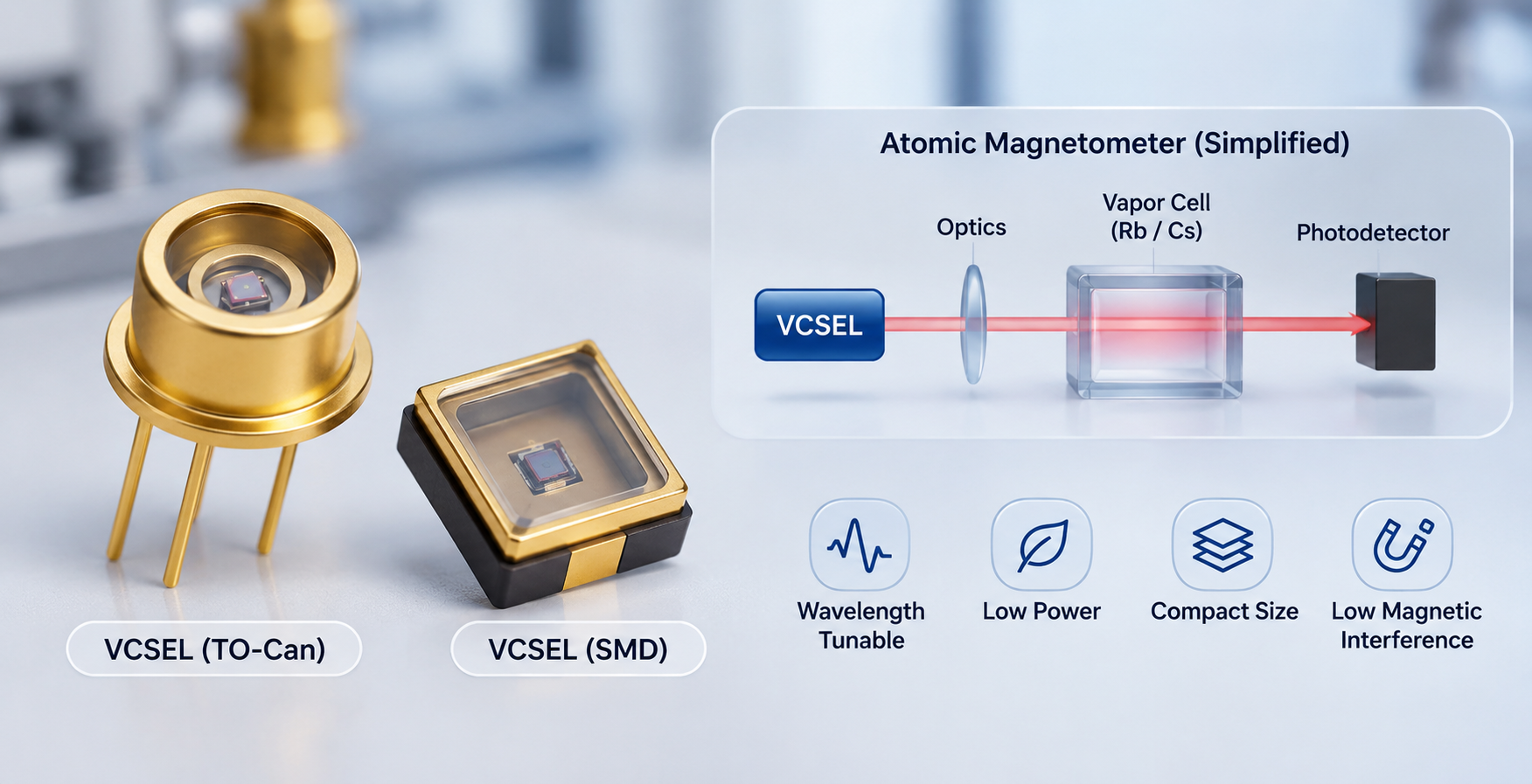
A typical miniature atomic magnetometer contains:
A VCSEL light source
A microfabricated alkali vapor cell
Polarization control optics
A vapor cell heating system
A photodetector
Laser current and temperature control circuits
Magnetic field control and signal-processing electronics
The laser must maintain a stable optical interaction with the atomic vapor. Changes in wavelength, intensity, or polarization can introduce measurement errors and reduce magnetic sensitivity.
Why VCSELs Are Used in Chip-Scale Atomic Magnetometers
Conventional laboratory atomic magnetometers often rely on external-cavity diode lasers or other relatively large optical sources. These devices can provide excellent spectral performance but may require additional space, electrical power, and optical components.
VCSELs offer a practical alternative for compact sensor designs.
A low power VCSEL for atomic magnetometers is particularly attractive in portable instruments, wearable magnetic sensors, and multi-channel quantum sensing systems where space and power consumption are limited.
Wavelength Selection for Atomic Magnetometers
The choice of laser wavelength depends on the alkali species and the atomic transition used for optical pumping.
Rubidium and cesium D1 transitions are commonly selected for miniature atomic magnetometers.
The exact operating frequency depends on the isotope, hyperfine transition, buffer gas pressure, and vapor cell conditions.
795 nm VCSELs for Rubidium Magnetometers
795 nm VCSELs are commonly used in rubidium-based optically pumped magnetometers, including spin-exchange relaxation-free (SERF) magnetometers and OPM-MEG systems.
The laser emission must overlap the required rubidium absorption profile under actual operating conditions. A nominal wavelength of 795 nm measured at room temperature may not be sufficient for a sensor operating at a different temperature or drive current.
Engineers should evaluate the emission spectrum across the intended operating range before selecting the device.
895 nm VCSELs for Cesium Magnetometers
895 nm VCSELs are suitable for optical pumping near the cesium D1 transition.
Cesium has a higher equilibrium vapor pressure than rubidium at the same temperature, which may allow certain sensor designs to achieve their required atomic density at lower cell temperatures.
Laser wavelength stability, polarization, and optical power remain important selection factors. The operating conditions of the vapor cell determine the required spectral characteristics.
Key Optical Parameters for VCSEL Selection
Two VCSELs with the same nominal wavelength and output power may produce different results inside an atomic magnetometer. Spectral characteristics, polarization behavior, and optical noise should be evaluated alongside conventional electrical specifications.
Optical Output Power
Higher laser power does not necessarily improve magnetic sensitivity.
Insufficient optical power reduces atomic spin polarization. Excessive optical pumping can broaden magnetic resonance and increase light-shift-related errors.
A 1 mW VCSEL provides a useful starting point for many miniature atomic sensor designs. Part of the emitted power is lost through polarizers, waveplates, optical windows, and other components.
The required optical power depends on:
Vapor cell dimensions and atomic density
Laser beam diameter
Optical transmission losses
Pumping and detection configurations
Atomic spin relaxation rates
The optimum operating power should be determined by measuring magnetic resonance amplitude, linewidth, and noise at different laser power levels.
Spectral Linewidth and Frequency Stability
The spectral linewidth of a VCSEL affects how its optical power is distributed across the atomic absorption profile.
A narrow linewidth can improve spectral selectivity. The benefits depend on the absorption bandwidth of the vapor cell, which is influenced by Doppler broadening, buffer gas pressure, and temperature.
Frequency stability is equally important. Even a narrow-linewidth laser can introduce measurement errors if its center frequency drifts away from the intended operating point.
Useful characterization data include:
Polarization Stability
Circularly polarized light is commonly used to prepare the atomic spin state in optically pumped magnetometers. A linearly polarized VCSEL combined with a quarter-wave plate provides a compact optical pumping arrangement.
Some VCSELs experience polarization switching when the drive current or operating temperature changes. This can alter the polarization state reaching the vapor cell and disturb the optical pumping process.
A stable polarization axis is particularly important in miniature sensors with fixed optical components.
The polarization extinction ratio (PER) and polarization direction should be measured across the expected current and temperature range.
Relative Intensity Noise
Relative intensity noise (RIN) describes fluctuations in laser output power relative to its average value.
These fluctuations can appear directly in photodetector signals or affect atomic spin polarization through changes in optical pumping intensity.
For precision magnetometers, noise should be evaluated within the actual measurement bandwidth. High-frequency RIN measurements alone may not reveal low-frequency fluctuations that affect weak magnetic field detection.
Low-noise current drivers, stable optical power, and balanced detection can help reduce intensity-related measurement errors.
Thermal Management and Wavelength Control
Temperature control is a major challenge in chip-scale atomic magnetometer integration. The vapor cell often requires heating, while the laser must maintain a stable emission wavelength.
Placing these components close together creates thermal coupling between the laser, heater, vapor cell, and surrounding structure.
Current and Temperature Tuning
VCSEL emission wavelengths typically shift as operating temperature and drive current increase.
Both tuning mechanisms can be used to position the laser emission near an atomic absorption line.
These illustrative values show why small temperature fluctuations can matter in atomic spectroscopy. Actual tuning coefficients vary with VCSEL design and operating conditions.
Temperature Stabilization
A thermistor combined with a thermoelectric cooler (TEC) can provide closed-loop temperature regulation.
Some miniature sensors use controlled resistive heating to reduce package complexity or operate the laser above ambient temperature.
The temperature control architecture should account for:
Ambient temperature variations
VCSEL self-heating
Thermal coupling from the vapor cell
Available electrical power
Required optical frequency stability
Sensor package dimensions
Atomic absorption references and frequency-locking circuits may be used when temperature stabilization alone cannot meet the required frequency stability.
Non-Magnetic VCSEL Packaging for Quantum Sensing
Magnetic cleanliness becomes increasingly important as the laser moves closer to the sensing volume.
Quantum magnetometers can detect extremely weak magnetic fields. Magnetic materials within a laser package may introduce local field offsets, magnetic gradients, and temperature-dependent measurement drift.
Standard semiconductor packaging materials are not always suitable for these applications.
Magnetic Contamination in Conventional Packages
Potential sources of magnetic contamination include nickel plating, Kovar headers, magnetic lead frames, solder materials, and assembly residues.
Material substitution alone cannot guarantee magnetic cleanliness. Manufacturing processes, plating layers, electrical connections, and assembly contamination also require evaluation.
Non-magnetic packaging does not eliminate magnetic fields generated by electrical currents. Heater wiring, laser current paths, and return conductors must be considered during system design.
Custom 795 nm and 895 nm Non-Magnetic VCSEL Solutions
Ace Photonics Co., Ltd. manufactures VCSEL chips, packaged devices, and customized laser solutions for quantum sensing and atomic spectroscopy.
We provide customized 795 nm and 895 nm 1 mW VCSEL non-magnetic packaging solutions for atomic magnetometers, OPM-MEG systems, and other magnetically sensitive instruments.
Available customization options include:
Magnetic or non-magnetic package structures
Package dimensions and mechanical interfaces
Optical window materials and dimensions
Window coatings and optical transmission requirements
Electrical connections
Thermal integration requirements
Package materials and optical configurations can be selected according to the customer's mechanical design, magnetic field budget, and operating environment.
Custom packaging gives engineers greater flexibility when integrating the laser into compact sensor heads without introducing unnecessary magnetic materials or optical components.
Optical Integration in Miniature Atomic Sensors
The optical path inside a chip-scale sensor may extend only a few millimeters. Beam divergence, window reflections, and alignment tolerances can influence the amount of light reaching the vapor cell.
Beam Divergence and Collimation
VCSELs generally produce relatively symmetrical optical beams, making them suitable for miniature optical assemblies.
The required beam diameter depends on the size of the vapor cell and the desired optical pumping intensity.
A beam that is too narrow may produce uneven spin polarization. An excessively wide beam wastes optical power outside the active sensing volume.
Microlenses and compact collimating optics can help match the VCSEL beam to the vapor cell geometry.
Optical Window Selection
The optical window should maintain adequate transmission and polarization quality at the selected operating wavelength.
Stress-induced birefringence deserves particular attention in sensors that rely on circularly polarized light.
Direct Integration vs Fiber-Coupled VCSELs
Two common optical configurations place the laser either close to the vapor cell or outside the magnetic sensing region.
Direct integration is attractive when compact dimensions and low component count are priorities. Fiber coupling is suitable when magnetic or thermal isolation is more important.
VCSEL Selection Checklist for Atomic Magnetometers
Before selecting a miniature atomic sensor laser, engineers should define the optical, electrical, thermal, and magnetic requirements of the complete system.
Device characterization should include L-I-V curves, temperature-dependent emission spectra, wavelength tuning curves, and polarization measurements. Magnetic characterization may also be necessary for high-sensitivity quantum sensing applications.
Building a Stable Chip-Scale Atomic Magnetometer
A suitable VCSEL must deliver stable optical power at the required atomic transition while meeting the sensor's electrical, thermal, and magnetic constraints.
For rubidium and cesium systems, 795 nm and 895 nm single-mode VCSELs offer a compact optical source for miniature atomic sensors. Customized non-magnetic packaging, wavelength stabilization, and carefully selected optical windows can help reduce interference and simplify integration.
Ace Photonics provides customized VCSEL solutions based on the optical specifications, packaging requirements, and operating conditions of each quantum sensing application.
Frequently Asked Questions
What wavelength is used in chip-scale atomic magnetometers?
Rubidium-based magnetometers commonly use 795 nm VCSELs near the D1 transition. Cesium-based systems often use 895 nm VCSELs. The exact operating frequency depends on the atomic transition and vapor cell conditions.
Is a 1 mW VCSEL suitable for atomic magnetometers?
A 1 mW VCSEL is a practical option for many miniature atomic sensors. The optimum power depends on beam diameter, atomic density, optical losses, and the required pumping intensity.
Why is non-magnetic VCSEL packaging important?
Magnetic materials near the vapor cell can introduce unwanted field offsets and gradients. Non-magnetic packaging helps reduce these effects in precision magnetometers and other quantum sensing instruments.
How does temperature affect VCSEL performance?
Temperature changes affect the VCSEL emission wavelength, threshold current, optical power, and potentially its polarization behavior. Temperature regulation helps maintain stable interaction with the atomic absorption transition.
Can VCSEL packages and optical windows be customized?
Yes. Ace Photonics provides customized magnetic and non-magnetic VCSEL packaging solutions. Package dimensions, optical window materials, coatings, and electrical connections can be adapted to customer requirements.