
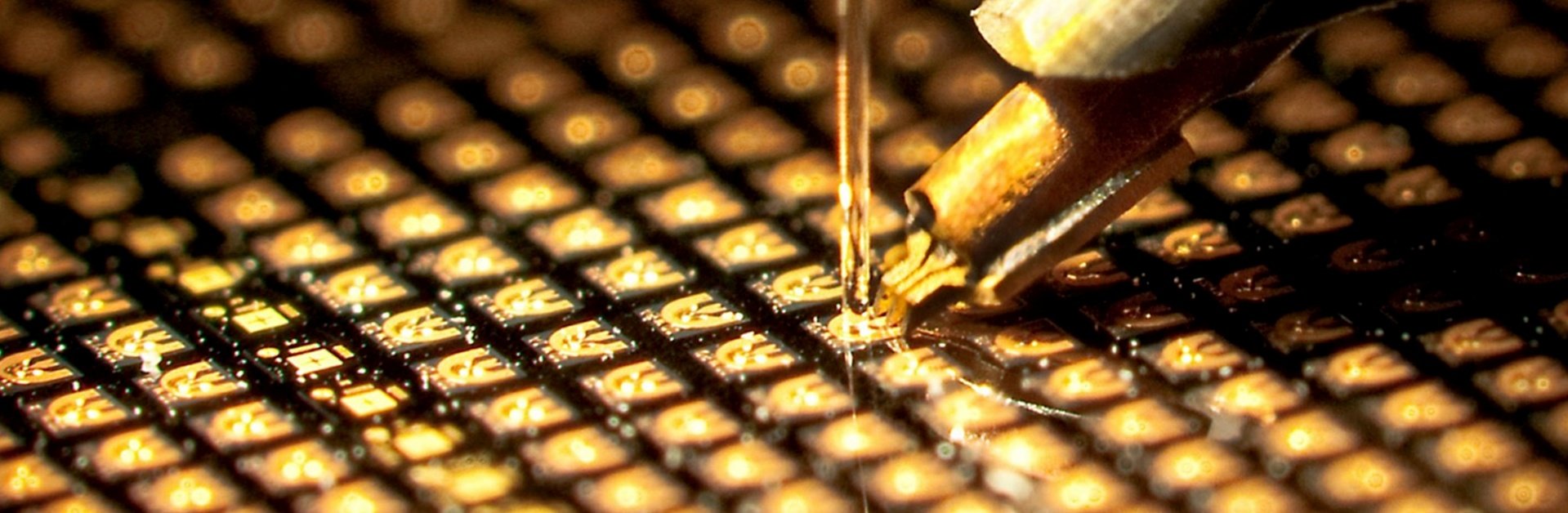
VCSEL Sensors from Ace Photonics: Redefining Industry Standards
As a specialist VCSEL manufacturer, Ace Photonics designs VCSEL sensors and light sources for customers who need precise, stable and scalable optical sensing – from quantum magnetometers and 3D facial recognition to LiDAR, medical monitoring and industrial automation.
By combining GaAs-based VCSEL dies, advanced non-magnetic packages and compact modules, we help OEMs turn demanding sensing concepts into reliable, manufacturable products.
What Is a VCSEL Sensor?
A VCSEL sensor combines a vertical-cavity surface-emitting laser (VCSEL) as the light source with optics, drivers and detectors to measure distance, motion, biometric features or chemical and environmental parameters.
Unlike edge-emitting lasers, VCSELs emit vertically from the chip surface, enabling:
Wafer-level testing and screening before packaging
High efficiency and low power consumption
Symmetric, low-divergence beams ideal for arrays and pattern projection
Excellent wavelength stability across temperature
These properties make VCSEL sensors ideal for compact, battery-powered and thermally challenging devices.
Ace Photonics supports VCSEL sensor makers with:
High-temperature operation up to 150 °C for harsh environments
Non-magnetic VCSEL packages for ultra-sensitive quantum sensors
VCSEL modules that integrate optics for compact, stable illumination

Key Application Fields of VCSEL Sensors
Gesture Recognition
VCSEL sensors project structured or flood infrared light and analyse the reflected pattern to detect hand movement and body gestures. This enables touch-free control in consumer electronics, smart home devices and automotive cabins, with low power draw and compact optical heads.
Biometric Authentication
In facial and iris recognition, VCSEL sensors illuminate the user with eye-safe infrared patterns. The stable wavelength and narrow divergence of our single-mode VCSELs help deliver high contrast, robust recognition even under changing ambient light.
3D Sensing
3D sensing is one of the most established VCSEL sensor markets. Ace Photonics VCSELs support structured light, time-of-flight and dot-pattern projection, providing: ACE PHOTONICS
High efficiency (often >45% in typical designs)
Chip-level micro-optics for diffuser-less illuminators
Narrow wavelength tolerance (≈ ±2 nm over temperature)
Low divergence beams for precise depth mapping
These advantages make our VCSELs suitable for smartphones, AR/VR headsets, robotics and industrial 3D inspection.
Automotive LiDAR
Automotive and industrial LiDAR platforms benefit from VCSEL arrays that combine scalable optical power with tight beam control. High modulation speed and robust temperature performance support long-range detection and fast scene updates in driver assistance and autonomous systems.
Industrial Automation
VCSEL sensors are increasingly used in Industry 4.0 environments for:
Position and distance measurement
Presence and level detection
High-speed object counting and sorting
Ace Photonics’ high-temperature-rated VCSELs help maintain sensor stability in hot production lines and power-electronics environments.
Healthcare Monitoring and Medical Imaging
From medical oxygen monitoring to optical blood-oxygen and tissue sensing, VCSEL sensors provide wavelength-specific, stable illumination. Ace Photonics has developed VCSELs tailored for oxygen sensor systems, where temperature stability and narrow linewidth directly improve measurement accuracy.
Environmental Sensing
VCSEL sensors can be tuned to wavelengths that interact strongly with gases or specific optical dyes. Their high modulation speed and wavelength stability are valuable in:
Gas concentration monitoring
Air quality and emissions sensing
Industrial safety systems
Security and Surveillance
In security cameras and access systems, VCSEL sensors provide invisible IR illumination for:
Night-vision imaging
3D scene reconstruction
Anti-spoofing in biometric access control
Stable, low-noise illumination improves signal-to-noise ratio and reduces false alarms.
Data Communication
VCSELs are a backbone technology for short-reach optical links inside data centres. When implemented in sensing-plus-communication modules, VCSEL sensors enable real-time monitoring and diagnostics alongside high-speed data transfer over multimode fibre.
How VCSEL Sensors Improve System Efficiency
Precision and Response Time
Because VCSELs can be tightly controlled in wavelength, power and beam profile, VCSEL sensors deliver:
High repeatability and nanometre-scale distance resolution in optical encoders
Millisecond-level response for gesture and motion detection
Stable output over temperature, reducing the need for bulky thermal control
For OEMs, this precision translates into simpler calibration, more compact electronics and higher measurement confidence.
Compact, Low-Power Design
Ace Photonics VCSEL modules combine a VCSEL array, micro-lens array (MLA) and optics in a compact housing, minimizing component count compared with traditional edge-emitting solutions.
Benefits for VCSEL sensor integration include:
Smaller sensor heads for wearables and handheld devices
Lower system power consumption and heat load
Easier scaling from a single channel to high-density arrays
Reliability in Harsh Environments
Our VCSEL technology is designed for high reliability and high operating temperature (up to 150 °C), making it suitable for automotive, industrial and aerospace-related sensing. Non-magnetic packaging options ensure that even ultra-sensitive quantum sensors retain accuracy by eliminating stray magnetic fields.
Impact on Industry Standards
As VCSEL sensors replace bulkier, less efficient light sources, they raise expectations for:
Wavelength stability across wide temperature ranges
Power efficiency, extending battery life and reducing cooling requirements
Beam quality, enabling precise depth maps and cleaner spectroscopic signals
Scalability, from single-device prototypes to high-volume production
Ace Photonics contributes to this shift with VCSEL dies, VCSEL modules and non-magnetic VCSEL packages that are designed from wafer to final package around demanding sensing use cases, including quantum sensing and 3D sensing.
Future Prospects for VCSEL Sensor Technology
Looking ahead, several trends will continue to expand what VCSEL sensors can do:
Advanced materials and epitaxy to further improve efficiency and extend wavelength coverage in the 750–1550 nm range
Higher-density arrays for finer 3D depth maps, wider fields of view and faster scanning
Tighter integration of VCSELs with drivers, detectors and on-chip optics for single-package sensor engines
Quantum-grade devices, where low noise, ultra-narrow linewidth and non-magnetic construction are standard features for quantum magnetometers and inertial sensors
From self-driving vehicles and collaborative robots to AR glasses and chip-scale quantum instruments, VCSEL sensors will remain a core building block.
Sustainability and Environmental Impact
VCSEL sensors also support sustainability goals:
High electrical-to-optical efficiency reduces power consumption and cooling needs
Wafer-level manufacturing and testing cut material waste compared with many discrete optical assemblies
Compact modules help shrink overall device size and material use
For applications such as environmental monitoring and medical oxygen sensing, VCSEL-based sensors not only consume less energy but also improve the quality of the data used to steer sustainability decisions.
Why Choose Ace Photonics for VCSEL Sensors?
Ace Photonics focuses on high-performance semiconductor lasers, primarily VCSELs and VECSELs in the 750–1550 nm range, and offers complete support from epitaxial design through chip processing and packaging.
Key strengths for VCSEL sensor customers include:
Over 20 years of VCSEL R&D experience from a Chinese Academy of Sciences team
GaAs-based VCSELs optimized for high efficiency and low thermal load
Non-magnetic packages and high-temperature solutions up to 150 °C
Custom design from wafer to packaging for 3D sensing, quantum sensing, industrial, medical and research applications
By combining flexible VCSEL dies, modules and packages with application-driven design, Ace Photonics helps you build VCSEL sensor solutions that meet today’s performance goals and tomorrow’s industry standards.